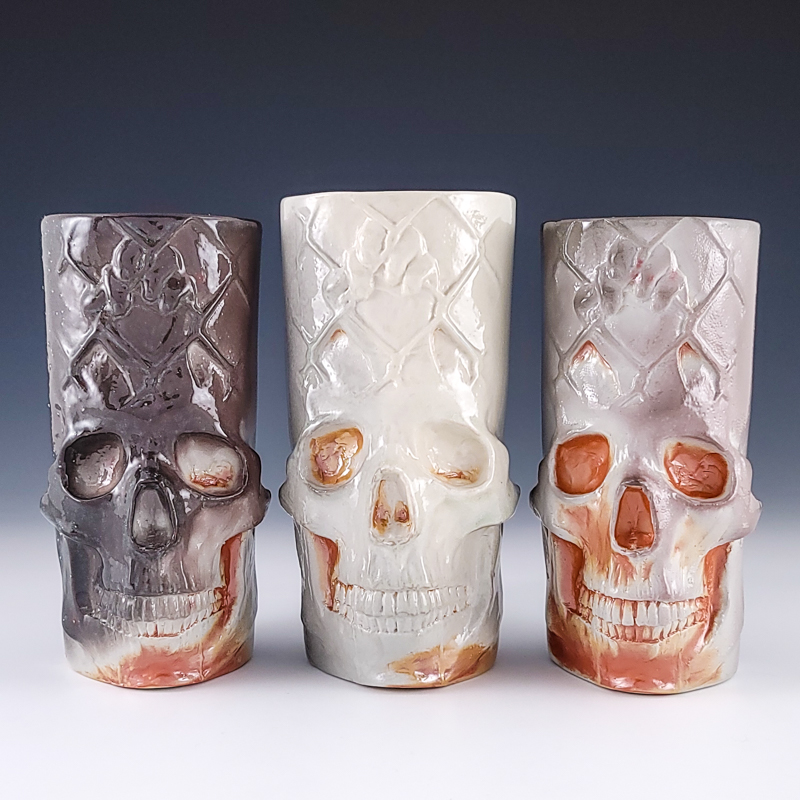
Candace Gooch-Ward is, among other obscure designations, a Tennessee-native ceramic artist. With her adolescence spent rooted on her family’s generational farmlands bordering lush a state forest, Candace first discovered her desire for a life in clay during Dick Lehman’s visiting artist demonstration at her university. She went on to spend her undergraduate summers working at Arrowmont School of Arts and Crafts and received her BFA (ceramics) in 2015. She has maintained her studio practice while teaching and working alongside other art and craft organizations in the time since. For a number of years her studio efforts focused primarily on production and participation in craft show circuits, during which she served for a time on the Governing Board of Tennessee Craft. Shifting her studio focus in Summer 2023, she joined Companion Gallery’s team where she continues to work and teach as a long term Artist in Residence. She currently resides in Jackson, Tennessee with her partner and beloved dog.
When not in the studio, Candace is likely to be found exchanging secrets with messengers of the fauna kingdom, perusing pages of manga at a preloved bookstore, rail riding by the subwoofers in a festive wilderness, holding communion in the woods with the trees, engaging with ghosts in a roadside antique shop, poorly practicing financial responsibility in a plant shop, or sharing a cigarette in the dead of night with the Moon. If she’s ever unaccounted for, she can usually be summoned with a ceremonial offering of a crisp Monster energy drink, a turquoise pack of American Spirits, or a small trinket imbued with an excessive amount of whimsy.
Candace Gooch-Ward's solo exhibition will be available online Friday, October 30th at 12 Noon CST.
--
Mike Cinelli Solo Exhibition
Mike Cinelli is a ceramic artist, father and occasional husband residing in Taylor, Mississippi. His work has been displayed nationally and internationally in numerous juried and invitational exhibitions, with work displayed as far away as Skopelos, Greece, where he attended a one month residency at the Skopelos Foundation for the Arts. He has received various jury awards, including the Studio Potter Merit Award. He was featured in the August 2016 issue of Ceramics Monthly as a contributor to “From Idea to Finished Form”. In March of 2019, his work was featured on the cover of Pottery Making Illustrated. Currently, he is attempting to juggle his studio practice, being a father and husband, and maintaining a rigorous schedule of complaining on the internet.
--
Material Mugs XI
2026 Participating Artists:
Grant Akiyama, Marissa Y Alexander, Alejandra Almuelle, Chris Alveshere, Juan Barroso, Ian Bassett, Jamie Bates, Eric Beavers, Casey Beck, Milo Berezin, Ashley Bevington, Andy Bissonnette, Nikki Blair, Bekah Bliss, Eric Botbyl, Evie Botbyl, Annie Boyer, Yael Braha, Angel Brame, Jessica Brandl, Matias Braun, Nathan Bray, Michael Bridges, Ray Brown, Wesley T. Brown, Laurie Caffery, Laura Casas, Pattie Chalmers, Adam Chau, Selina Chen, Ian Childers, Marissa Childers, Mike Cinelli, Andrew Clark, Bede Clarke, A. Blair Clemo, Jenn Cole, Savanah Conrad, Gabs Conway, Jillian Cooper, Lyndee Deal, Dehmie Dehmlow, Audra Doughty, Carole Epp, Michelle Ettrick, Tanya Everard, Lauren Faust, Katie Fee, Yoshi Fujii, Steph Galli, Andrea Garcia, Forrest Sincoff Gard, Joey Gerace, Mike Gesiakowski, Candace Gooch-Ward, Delvin Goode, Clara Grams, Chris Gray, Kyle Guymon, John R Hamilton III, Casey Ann Hanrahan, Steve Hansen, Dane Hodges, Shannon Hogarty, Alisa (AL) Holen, Samantha Hostert, Haylie Jimenez, Kirsty Kash, Kristen Kieffer, Tim Kowalczyk, David Kenton Kring, Jessie Kristy, Marina Kuchinski, YoonJee Kwak, Bri Larson, Stacy Larson, Robert Lawarre III, Justin Leavitt, JeeEun Lee, Kyle Scott Lee, Keok B Lim, Renee LoPresti, Coleton Lunt, Anika Major, Tammy Marinuzzi, Macgregor Mason, Liz Mazurek, Will McComb, Taylor Mezo, Sam Momeyer, Christian A Morris, Sarah Mundy, Richard Munster, Melissa Mytty, José Flores Nava, Samuel Newman, CJ Niehaus, NOM Ceramics, Erika Novak, KyoungHwa Oh, Joe Page, Doug Peltzman, Ronan Kyle Peterson, Stephen Phillips, Zoë Pinnell, Todd Pletcher, Ashlyn Pope, Melodie Reay, Taylor Robenalt, Justin Rothshank, Johannette Rowley, Dwayne Nii-Teiko Sackey, Rosa Salas, Amy Sanders, Brian Sarama, Masa Sasaki, Ali Schorman, Chanakarn Semachai (Punch), Taylor Sijan, Malcolm Mobutu Smith, Ryan Smith, Shawn S. Spangler, Constance Stotzer, Olivia Tani, Zach Tate, Chance Taylor, Alex Thomure, James Tingey, C.A. Traen, Sami Tsang, Nala C. Turner, Matt Watterson, Taylor Whyte, Travis Winters, Julie Woodrow, Dexter Woods, Meghan Yarnell, Qi Zhang, Rebecca Zweibel
Collector’s Guide
For convenience, we've resorted the entire exhibition with all available works in the first few pages.
--
Ewers Invitational II
The inception of this show began several years ago as a modest studio garden. We’d take little breaks during the day to admire the small changes unfolding before us–a sprouting seed, a bee meandering from flower to flower, our first tomato. This back and forth between the studio and garden has strengthened the connection between the pots we make and the food we grow.
In the kitchen, it seems that the crowning achievement of any homegrown vegetable is being slathered in extra virgin olive oil, vinegar, balsamic glaze, or chili oil. Enter the ewer.
It was the garden that encouraged us to visit and revisit this dynamic and historical form. Last year, we hosted the first Ewer Invitational here at Companion Gallery, and we’re so excited to share another iteration with you all. We sent invitations out while our seedlings were still under growlights, and the garden is now overflowing as arrivals file in. We’re in awe of the diversity in form, scale, and overall interpretation of each ewer presented here.
The exhibition opens this Friday, July 24th at 12 noon CST, just in time for peak farmer’s market and backyard garden season.
Participating artists include: Eric Beavers, Casey Beck, Ashley Bevington, Eric Botbyl, Evie Botbyl, Cory Brown, Ray Brown, Ben Carter, Marissa Childers, Mike Cinelli, Andrew Clark, A. Blair Clemo, Dehmie Dehmlow, Marty Fielding, Seth Green, Martha Grover, Shikha Joshi, Ashton Keen, Heather Lepp, Liz Mazurek, Lorna Meaden, Ted Neal, NOM Ceramics, Ronan Kyle Peterson, Taylor Sijan, Shawn S. Spangler, Jon Stein, Mike Stumbras, David Swenson, Olivia Tani, Zach Tate, Nathan Willever
--
Alisa (AL) Holen Solo Exhibition
“I was born and raised in Minneapolis, MN with an artist for a father. Clay was always part of life in our suburban home. Dad had a studio downstairs and kilns in the garage. Mom served meals in pots made by Warren MacKenzie, Chuck Halling and Peter Leach. I have been lucky enough to never know a life without clay. That said, my father (Norman Holen) is a sculptor. Much of his work is displayed in the home with curatorial acumen. it’s like living in my favorite museum. When I began working with clay outside of college, and considering it as a career, I was drawn to the fact that functional work goes into other people’s homes, and is used. Despite this, my upbringing led me to work that also has a sculptural presence. I enjoy walking this line and sometimes making the work unapproachable. I also enjoy making the work so tactile and inviting that touching it seems irresistible. Form and Surface are at the heart of both the sculptural and the functional object, and they are where I focus my attention. Teaching takes up the majority of my time, but I try to get into the studio for some work time each week. When spring break or summer allow me more time, I find that the work takes on new directions. This is always exciting!
Teaching is something that I feel extremely lucky to do. The relationships that I build with these young artists keeps me excited about everything in the field. The questions that they ask often cause me to dig and question my own motivations. And when the “light bulb” comes on for one of them, it is the most satisfying thing that I can imagine. I love my career, and I love my material, I have a fantastic husband, and a sweet cat. Pretty much have this life thing nailed.
The majority of my work is fired to cone 10 in light reduction. I have formulated the glazes that I use to work very well with a dark clay body that is a hybrid of a dark porcelain. Over much trial and error, it is now almost a self-glazing stoneware. The feldspar content is quite high, which helps my reticulating glaze stay with the clay through daily use, and leaves a nice tight surface on the unglazed portions of the work. I work with a lot of wheel-thrown inflated, closed, and double walled forms which give the pieces the volume that I crave. I really enjoy clay’s ability to stretch and deflate in different stages, and hope to continue to with this work for years to come. Relationships change, so the work changes, but rarely in huge jumps. There are nuances and subtleties that shift and realign. I try to pick up on these changes and work them into the clay, while keeping function and the physical presence of the work at the forefront.” - AL Holen
--
Juan Barroso Solo Exhibition
Juan Barroso’s work is about the plight, struggle, hope, and heritage of Mexican immigrants to the United States. His pots are slip cast from original designs with colored porcelain. Barroso’s imagery is hand painted with underglazes or carved in low relief. All works are fired to cone 10 in oxidation.
Barroso earned his M.F.A. in Ceramics from the University of North Texas in 2020 before his three year residency at Companion Gallery. All works were created in his home studio in Princeton, TX where he continues his studio practice and works as a ceramic educator.
--
Text Messages III
This is a show about pots and words. Not spoken, but visual words... stacked together, stretched out, strung together, cursive, typed, painted, carved, broken up bits of words. Even just the idea of words. Illegible words. Words that rhyme. Full sentences or paragraphs. Words as pattern. Words just for the line of it.
"I always thought of words as art supplies." -Douglas Coupland
10 potters have all contributed 1 place setting each and a table is being set in the midst of the gallery. You can expect to find plates, bowls, cups, mugs, as well as a few wild cards.
Our esteemed dinner guests are as follows...
Ashley Akerson, Laura Caroline Casas, Delvin Goode, Steve Hansen, Tim Kowalczyk, Forrest Lesch-Middelton, Keok B Lim, CJ Niehaus, Justin Rothshank, Rebecca Zweibel
--
Ceramics 2026/Spring Exhibition
We are excited to announce our upcoming group exhibition, Ceramics 2026. This exhibition originated in 2020, where we had planned a series of exhibitions at NCECA in Richmond, VA. When the conference was canceled at the last minute (for very good reason) we pivoted, had everything redirected, and hosted the exhibition here at the gallery. It was a frantic, whirlwind experience which has evolved into an annual exhibition and Spring tradition here at Companion Gallery.
We now view the spring exhibition (Ceramics 2026) as an annual survey, highlighting the best of contemporary functional & sculptural ceramics. Our aim is to highlight emerging artists alongside mid-career and veteran makers.
Participating artists:
Olivia Avery, Eric Botbyl, Evie Botbyl, Annie Boyer, Jessica Brandl, Ray Brown, Dawn Candy, Marissa Childers, Ian Childers, Andrew Clark, Mike Cinelli, Andrea Garcia, Candace Gooch-Ward, Steve Hansen, Tim Kowalczyk, YoonJee Kwak, Bri Larson, Liz Mazurek, Christian A. Morris, Marcè Nixon-Washington, Be Rose, Ali Schorman, Amy Smith, Malcolm Mobutu Smith, Zach Tate
SHOP NOW